
What is Multi-Agent AI? The Art of “Divide and Conquer”
Chatbot or Agent?
The term is trending right now: it’s not uncommon to hear that such-and-such company offers Multi-Agent AI or that the latest chatbot is “agentic .” But what does that actually mean? We’ll answer that, but first, let’s distinguish between chatbot and agent.
An agent is an autonomous system that has knowledge of its environment, a goal, and tools to achieve it. Take the most famous robot vacuum: the Roomba! Its objective is to clean the room, it has sensors to “visualize” its environment, and it can perform actions such as turning, vacuuming, or returning to its charging station. There you have it—that’s an agent! No LLM, no deep learning, just hand-coded rules and a simple algorithmic model.
The chatbot, on the other hand, aims to converse with a human (or another chatbot!), but doesn’t necessarily have tools at its disposal or an interaction environment. The first chatbot example, named ELIZA, simulated Rogerian psychology. The most recent ones, based on LLMs like GPT or Gemini, seem to know everything. No sensors, no actions, just a brain. This brain can be a simple series of hand-coded instructions or a more advanced deep learning algorithm like a generative model.
“What about the latest chatbots like GPT or Gemini? They can query the web, connect to APIs, send emails… Aren’t those actions?” Good catch! Recent chatbots are actually… Conversational Agents! They’re the logical intersection of agentic systems with a chatbot brain (generative model).
If the difference between chatbot, LLM, and agent interests you, we’ve also written an article specifically on the topic: Chatbot vs AI Agent: Why Your “Good Old” Chatbot Disappoints (and How to Make It Useful)
Multi-Agent
One agent is good, but are two agents better? It’s not that simple to say and depends on the tasks to be accomplished. When using a single generalist agent to do everything, you quickly run into what’s called the complexity problem.
The Limits of Single-Agent
When facing a complex task, entrusting all responsibilities to a single “do-it-all ” agent exposes the system to numerous limitations. First, the model inherits the intrinsic weaknesses of LLMs: saturation of the context window, temporal disconnection, and the infamous hallucinations. . Next, by giving it access to a multitude of tools (sometimes 50 different tools), the prompt becomes enormous and contradictory, which disorients the model and pushes it to make poor action choices. From a software perspective, this lack of separation of concerns creates a monolith that’s impossible to debug or test individually. Finally, it poses a major problem in terms of cost and robustness: running an overpowered model for the slightest micro-decision quickly becomes expensive, and if this single agent fails, the entire system becomes unavailable (the infamous Single Point of Failure).
The Solution: Multi-Agent
The solution comes from a fundamental principle of software engineering: “Divide and conquer .” This is the very essence of the multi-agent paradigm: breaking down a complex problem into easier-to-handle sub-problems, where one agent equals one expertise and one well-defined responsibility. The goal is to create multiple agents that are smaller but hyper-specialized. . This reduces hallucinations, optimizes efficiency by using fast models adapted to each task, and isolates risks to make the overall system much more maintainable and robust.
Architectures and Communication Paradigms
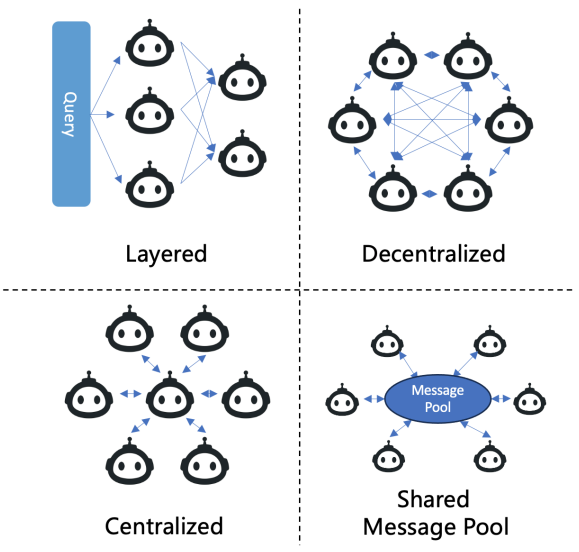
But how do you organize these agents among themselves? It depends on the chosen architecture style and paradigm. Agents can interact in a cooperative manner (they share a common goal to solve the problem), through debate (they argue and critique each other to iteratively improve the result), or even competitively (their goals diverge and they must negotiate to find a balance). To orchestrate all this, the most common organization is the Coordinator / Dispatcher pattern, a hierarchical architecture where a central entry agent receives the request and routes it to the most suitable specialist. There are of course other approaches, like the Sequential Pipeline (where agents execute in a chain, with one’s output becoming the next’s input) or the Fan-Out / Gather approach (where multiple agents work in parallel before a final agent synthesizes their results). Whatever the method, the ultimate goal remains the same: mobilize the perfect expert at the right time to provide an accurate answer.
OUR NEXT TECH ARTICLE WILL DISCUSS THESE DIFFERENT ARCHITECTURES
An Example: The Virtual Hotel Concierge
To illustrate this concept, imagine the automated customer service of a large hotel. Instead of asking a single agent to handle all complex customer requests (with the risk of getting tangled up in schedules or hallucinating availability), we can deploy a real team of specialized agents:
- The Reception Agent (the Orchestrator): Its role is to talk with the customer, understand their overall needs, and distribute tasks to the right experts.
- The Reservation Agent: Connected to the hotel management system Mews, it exclusively handles checking room availability, blocking dates, and managing billing.
- The Room Service & Spa Agent: It exclusively manages internal services. It has perfect knowledge of real-time menus and available massage slots in an internal RAG.
- The Local Guide Agent: Connected to Geotrek and The Fork, its mission is to find the best nearby hikes and book tables at outside restaurants.
If a customer asks: “I’d like to book a suite for this weekend, with a couples massage on Saturday afternoon and a table at a good seafood restaurant in the evening”, the Reception Agent breaks down the request. It delegates the suite to the Reservation Agent, the massage to the Spa Agent, and the restaurant search to the Guide Agent. Once each specialist has completed their mission, the Reception Agent compiles the confirmations and presents a perfectly organized stay to the customer. Each to their own trade, for impeccable service!
Take It to the Next Level with Virage AI
At Virage AI, we design and implement custom conversational agents for you, capable of handling this type of complex request. Because every business is unique, our systems interface directly with your own data sources (APIs, databases, business software, internal documents) and deploy your agents directly on your networks (WhatsApp, Messenger, Instagram, Email, Web integration). Whether it’s to revolutionize your customer service, automate your internal processes, or assist your employees, we support you from A to Z. Ready to take the leap into agentic AI? Contact us to discuss!
Sources
Conversational Agents and Agentic AI
– Dr Benjamin Molinet
Multi-Agent Architectures:
Large Language Model based Multi-Agents: A Survey of Progress and Challenges
Attention distribution limitation:


